
 EN
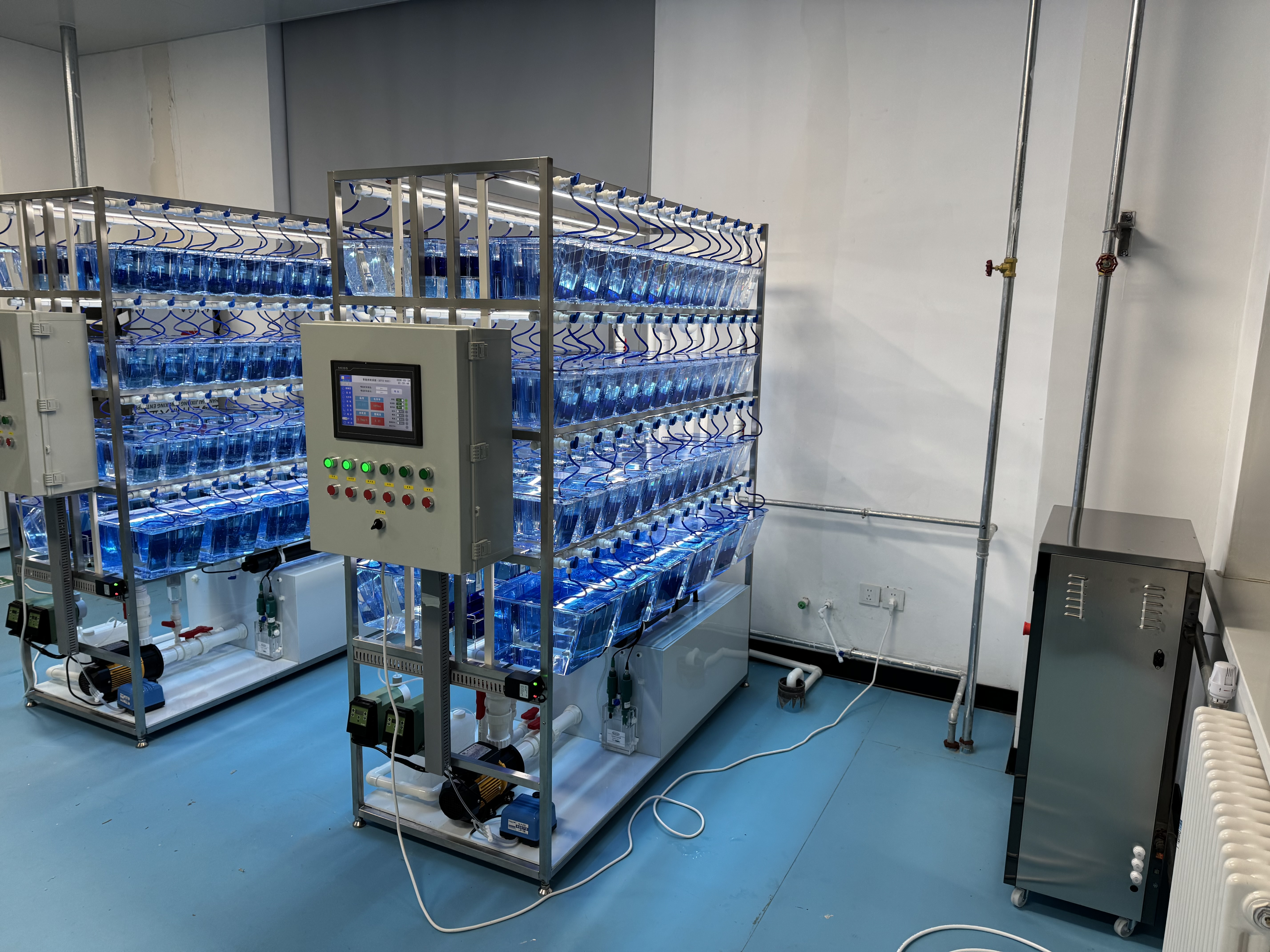
Why Humidity Belongs in the Same Conversation as Temperature
Zebrafish incubators get judged mostly by temperature stability, water flow, and filtration. Humidity control often sits further down the checklist. That ranking does not match what happens inside a working unit. Air holds moisture, and the gap between the water surface and the surrounding air drives evaporation. When relative humidity drops, water leaves tanks and plates faster. When it climbs, condensation forms on lids, walls, and sensors. Both directions create problems that look like water quality issues, even when the root cause sits in the air.
Warmer air can hold more water vapor, so a tank at 28°C inside an incubator with dry air will lose water faster than the same tank in a humid room. That loss changes the concentration of dissolved salts, medication, and buffer compounds over time.
How Evaporation and Condensation Quietly Change Water Chemistry
Evaporation removes water and leaves dissolved solids behind. Conductivity rises. pH can drift as carbonate chemistry shifts. In small volumes, the change happens faster. Embryo plates and larval rearing containers are especially vulnerable because they hold only a thin layer of liquid. A modest drop in water level can shift osmolarity enough to affect development.
Condensation is the other side of the same coin. Water that leaves the tank has to land somewhere. It can collect on the incubator ceiling and drip back into tanks, carrying dust or microbes. It can pool around electrical connections. It can also create a wet zone that supports mold growth on gaskets and shelving. Neither evaporation nor condensation is automatically catastrophic, but both are hard to diagnose when humidity is not measured.
| Humidity Condition | Likely Effect on Incubator | Common Misread as |
|---|---|---|
| Low relative humidity | Faster evaporation, rising conductivity, lower water levels | Dosing error or high evaporation rate |
| High relative humidity | Condensation on lids and walls, wet surfaces | Leak or spill |
| Rapid humidity swings | Unstable osmotic conditions in plates | Embryo quality issue |
| Stratified humidity by shelf | Rack to rack variability | Genetic or handling difference |
What Happens to Embryos When Humidity Swings
Zebrafish embryos develop in water, but the water sits in an air environment. In a multi-shelf incubator, the air around each plate matters. Low humidity pulls water out of shallow wells. High humidity can dilute a well if condensation drips into it. Both conditions add variability that experimental designs try to avoid.
The Guide for the Care and Use of Laboratory Animals suggests a relative humidity range of roughly 30 to 70 percent for many animal housing environments. That is broad. A zebrafish incubator does not need to mimic a tropical rainforest. It needs moisture stable enough that evaporation and condensation stay predictable. Consistency matters more than the exact setpoint. A unit that holds a steady mid-range humidity with small swings will usually outperform one that averages a similar level but swings widely every day.
Control Strategies That Keep Moisture in the Right Range
Humidity control in a zebrafish incubator can be passive, active, or a mix of both. Passive approaches include water trays, large surface area reservoirs, and sealed door gaskets. Active approaches include ultrasonic humidifiers, steam injection, membrane humidification, and mechanical dehumidification. The right choice depends on room conditions, door traffic, and heat from lighting.
-
Passive water trays are cheap and quiet, but respond slowly and can become microbial reservoirs.
-
Ultrasonic humidifiers react quickly, yet fine droplets can leave mineral dust if water quality is poor.
-
Steam humidifiers avoid droplets, but add heat and require careful plumbing.
-
Mechanical dehumidification helps in humid rooms, but adds a heat load and needs drainage.
-
Sealed cabinets and good door gaskets reduce exchange with the room, improving any control strategy.
A common mistake is oversizing an active humidifier for a small incubator. Humidity overshoots, condensation forms, and the controller fights itself. A smaller unit with proportional control usually gives better stability.
Monitoring Humidity Without Overcomplicating the Setup
A humidity sensor is only useful if it is placed where the animals live. Sensors near the door or next to a heater will read conditions that do not match the shelf environment. At least one sensor per rack zone, or a portable logger moved between shelves, can reveal stratification. Calibration matters too, because low cost sensors drift over time in warm and wet conditions.
A case from a coastal research facility illustrates the point. During a renovation, several zebrafish incubators had been running with no humidity logging. Over a few weeks, staff noticed water levels dropping faster than expected and conductivity creeping upward. Spawning output also became less consistent, while temperature logs looked normal. The problem turned out to be a room HVAC change that lowered ambient humidity near the intake side of the racks. Adding simple humidity logging showed the pattern immediately. The fix involved adjusting room ventilation and adding passive humidity buffering near the affected racks. Humidity data would have shortened the diagnosis from weeks to days.
Where Humidity Control Fits in Real Facility Design
Humidity control cannot be treated as a standalone feature. It interacts with temperature, air exchange, lighting, and door traffic. A well sealed incubator with low thermal gain will hold moisture more predictably than a leaky unit with high heat output. Room level HVAC also matters. Dry winter air turns every incubator into a dehumidifier. Humid room air raises condensation risk.
For labs specifying zebrafish incubators, the practical question is not whether humidity control exists on a datasheet. The question is whether the system can hold a stable moisture band through seasonal changes, power events, and normal husbandry. That requires consistent manufacturing, reliable sensors, and a control design that does not fight itself.
Hunter Lab approaches zebrafish experimental equipment with that system level view, emphasizing manufacturing consistency, quality control, and supply chain reliability so humidity behavior stays predictable across units and over time.








