Hunter Laboratory joined the 3rd Hope for Rare Science Conference — also known as the China Rare Disease Research Conference — in Shanghai from June 25 to 27, 2026. Organized by the Ruiou Public Welfare Foundation and co-hosted by the National Children's Medical Center, Children's Hospital of Fudan University, and the CORD Rare Disease Center, the event brought together more than 150 leading experts from 15 countries and over 1,000 researchers and industry professionals. Hunter Laboratory presented its Zebrafish Rare Disease Model Development and Rapid AI Drug Screening and Validation Platform, alongside original research conducted on an autism-related zebrafish gene editing model.

The Challenge Facing Rare Disease Research
During the conference opening, Huang Rufang, Founder and Secretary-General of the Ruiou Public Welfare Foundation, highlighted a persistent reality: more than 95% of rare diseases worldwide still have no effective treatment options. Establishing biologically relevant disease models, identifying druggable genetic targets, and running early-stage compound screening all require significant time and specialized resources — challenges that are especially acute when patient populations are small and disease mechanisms are poorly understood.
For rare disease drug discovery, the ability to move quickly from gene identification to functional validation and in vivo compound testing can make a meaningful difference. Purpose-built zebrafish rare disease model platforms offer one practical path forward, combining the biological relevance of an intact living organism with the throughput advantages that early-stage drug screening demands.
CHD8 Autism Research: Key Findings from the Conference Poster
Hunter Laboratory presented a scientific poster titled "CHD8 Deficiency Induces Autism-Like Phenotypes in Zebrafish Crispant Models." The study used CRISPR-based zebrafish gene editing to generate an F0 mosaic crispant model carrying a CHD8 loss-of-function mutation. CHD8 — Chromodomain Helicase DNA-Binding Protein 8 — is widely recognized as one of the strongest genetic risk genes for autism spectrum disorder (ASD), though the downstream biological mechanisms connecting CHD8 deficiency to neurodevelopmental abnormalities are not yet fully characterized.
Using this zebrafish rare disease model, Hunter Laboratory's research team identified three categories of findings:
-
Disrupted glial cell development. A significant increase in astrocyte-related signals and an upward trend in oligodendrocyte-related signals were observed. Both cell types play critical roles in supporting neuronal development and maintaining the neural environment — disruptions in these populations may indicate that CHD8 deficiency interferes with the cellular conditions required for normal brain development.
-
Impaired inhibitory neuronal signaling. Localized reductions in inhibitory neuronal activity were observed in the forebrain region, suggesting disruption of the excitation-inhibition balance that has been widely studied as a contributing mechanism in ASD-related neural network abnormalities.
-
Autism-relevant behavioral and structural phenotypes. The CHD8-deficient zebrafish displayed impaired social behavior, repetitive or stereotyped movements, and observable changes in brain structure consistent with established ASD research criteria.
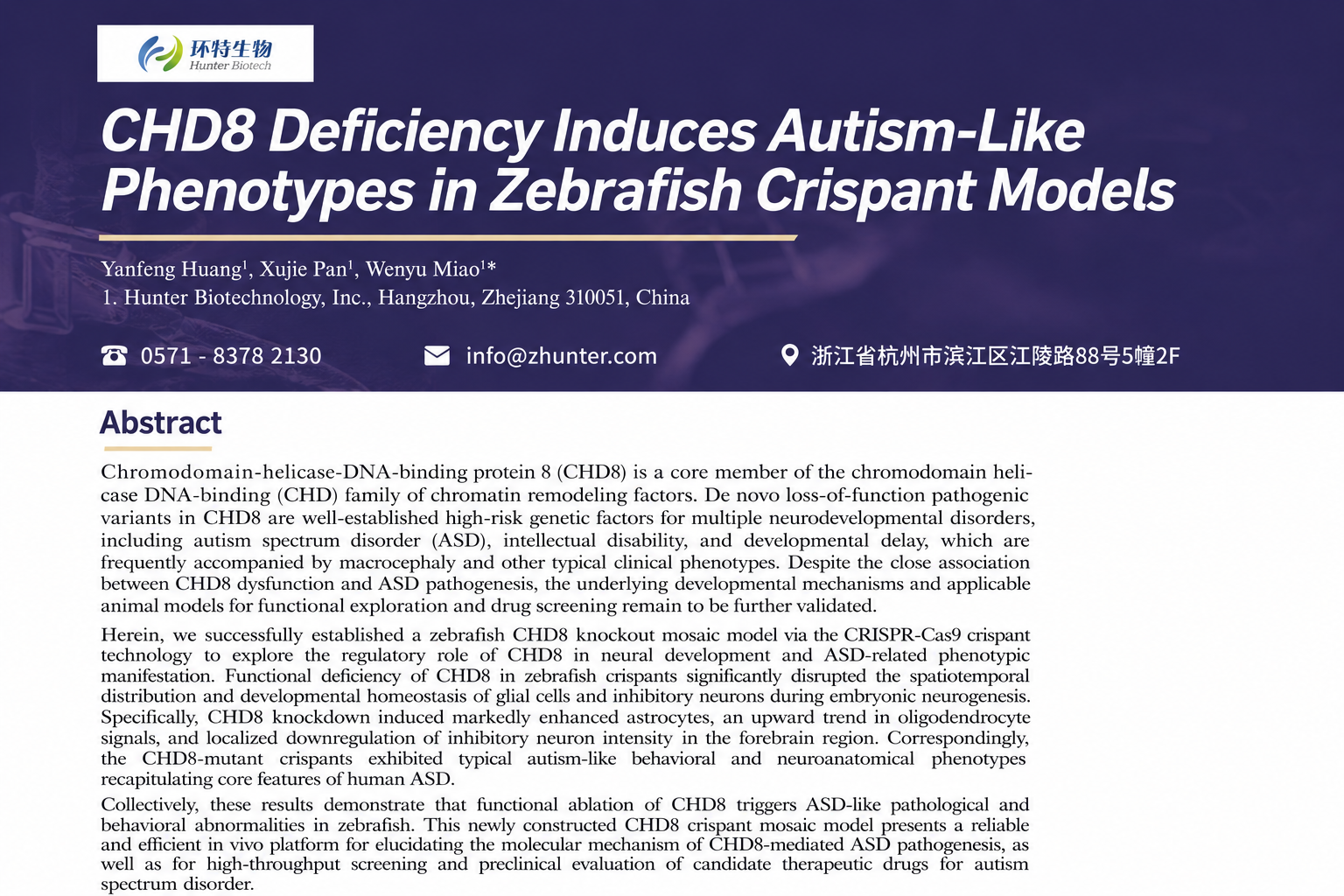
This zebrafish disease model provides an in vivo platform for investigating CHD8-related mechanisms and evaluating potential therapeutic candidates through high-throughput compound screening — a practical complement to cell-based and mammalian model approaches.
The Zebrafish AI Drug Screening and Validation Platform
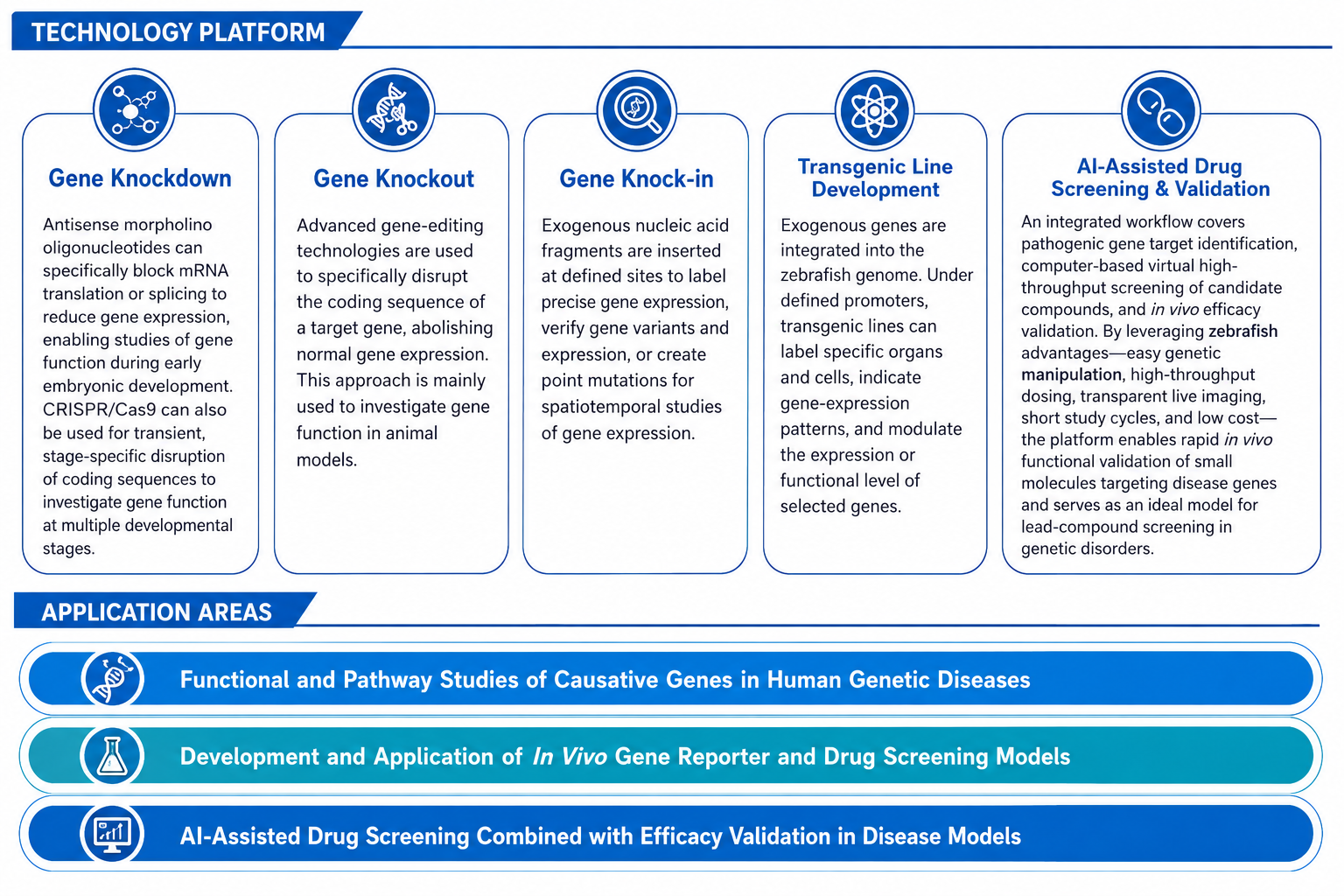
Hunter Laboratory also showcased its broader Zebrafish Rare Disease Model Development and Rapid AI Drug Screening and Validation Platform. The platform integrates zebrafish gene editing, AI-assisted virtual compound screening, in vivo biological validation, and organoid-based confirmation into a continuous drug discovery workflow — allowing researchers to move from disease gene identification to early compound prioritization and in vivo efficacy testing within a single connected system.
The core workflow includes:
- Identification and functional validation of disease-associated genes
- Investigation of relevant molecular pathways and disease mechanisms
- AI-assisted virtual screening of candidate compounds
- Development of zebrafish disease models or gene reporter models
- High-throughput in vivo compound screening and efficacy evaluation
- Further validation using organoid systems where applicable
By pairing computational compound prioritization with rapid zebrafish in vivo testing, the platform reduces the number of candidates that need to advance into more resource-intensive stages — a meaningful advantage in rare disease drug discovery where project timelines and budgets are often constrained.
Why Zebrafish Are Well-Suited for Rare Disease Drug Discovery
Zebrafish share a large proportion of conserved genes, biological pathways, organs, and physiological processes with humans, making them biologically relevant for studying human genetic conditions. Their embryos are optically transparent, enabling real-time observation of developmental, neural, vascular, and morphological changes in living animals at a level of detail that is difficult to achieve with other model organisms at equivalent throughput.
From a practical standpoint, zebrafish offer several specific advantages for rare disease research:
- Rapid generation of gene-edited rare disease models
- High-throughput compound administration and in vivo drug screening
- Short experimental cycles with lower compound consumption per test
- Quantifiable behavioral and morphological endpoints
- Direct visualization of living biological processes in real time
- Compatibility with automated imaging and behavioral analysis systems
These properties make zebrafish particularly practical for early-stage rare disease drug discovery — helping research teams identify phenotype-rescuing compounds and establish preliminary efficacy evidence before committing to longer and more costly mammalian model stages.
Hunter Laboratory's Technical Services and Research Track Record
Hunter Laboratory's technical services span functional validation of disease-associated genes, zebrafish gene editing disease model development, AI-assisted virtual compound screening, in vivo efficacy validation, early safety and toxicity evaluation, and support for gene therapy and precision medicine research. To date, Hunter Laboratory has completed more than 12,000 research projects for over 3,000 clients and partners — a body of work that reflects extensive hands-on experience across zebrafish model types, experimental designs, phenotype readouts, and data analysis workflows.

Hunter Laboratory's participation in the 3rd Hope for Rare Science Conference reflects the growing role of zebrafish gene editing and AI drug screening in rare disease research. As researchers worldwide work toward closing the treatment gap for rare genetic conditions, Hunter Laboratory remains committed to advancing its zebrafish rare disease model capabilities and integrated drug screening services — supporting faster, more reliable pathways from genetic target identification to validated therapeutic candidate.

 EN








