
 EN
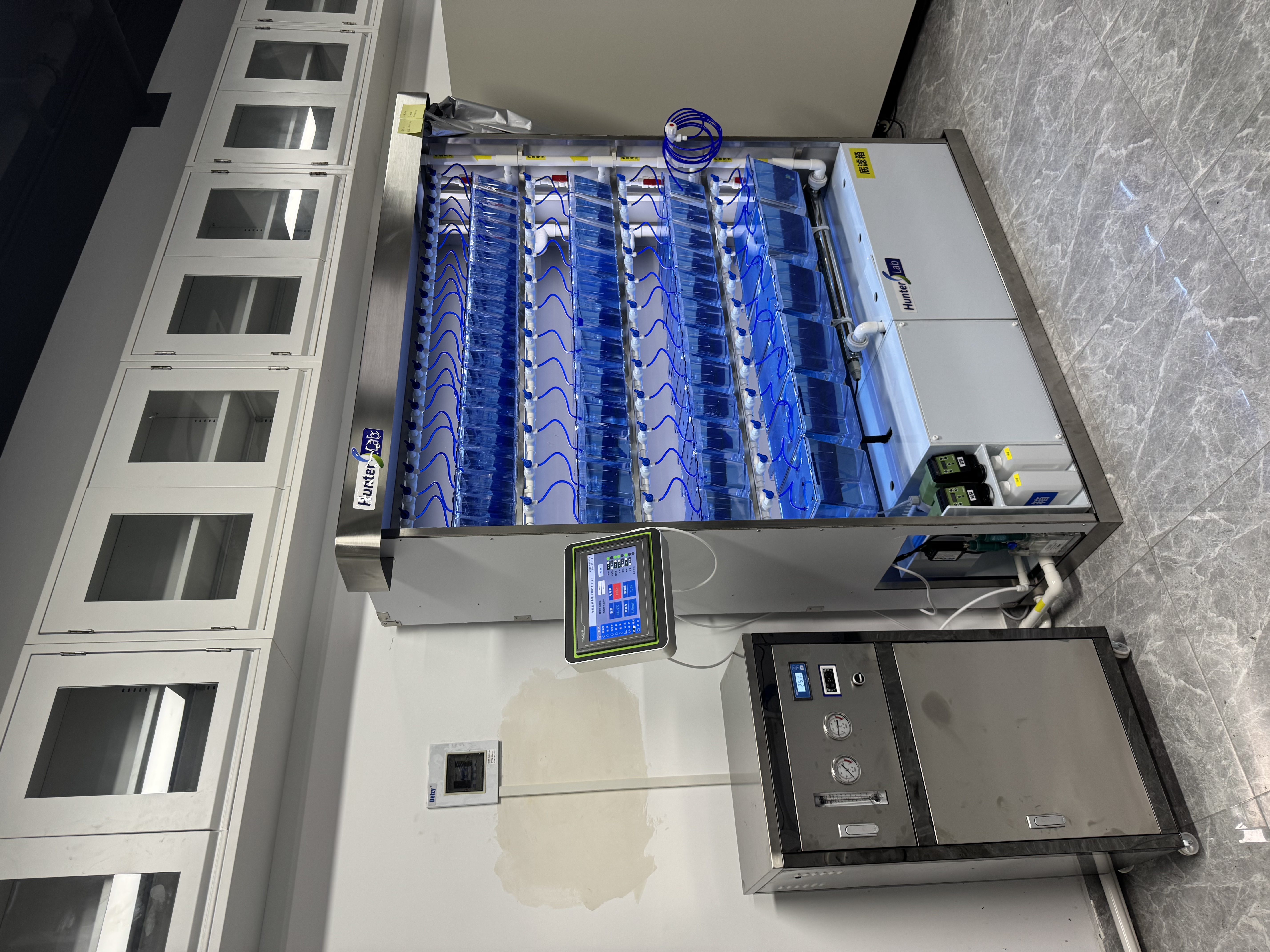
A Zebrafish Automated Feeding System matters in circadian work because it turns feeding time from an informal husbandry routine into a defined experimental input. For a lab studying daily activity, metabolism, behavior, or molecular rhythms, knowing that fish were fed “in the morning” is not enough. The timing, frequency, ration, and consistency of each delivery can influence the conditions under which animals are observed. A programmable schedule gives the team a repeatable record of that exposure.
That does not mean a Zebrafish Automated Feeding System replaces careful study design. Light-dark cycles, water conditions, developmental stage, stocking density, handling, and the chosen endpoint still matter. It does mean that feeding can be controlled with the same discipline used for other time-sensitive variables. For circadian experiments, that distinction is often central to interpreting a result.
Feeding time is more than a care task
Zebrafish are widely used to study vertebrate biological rhythms because daily changes can be measured across behavior, physiology, and gene expression. Light is a prominent timing cue, but food timing can also provide a signal to the organism. Research on zebrafish feeding entrainment describes scheduled meals as a potential zeitgeber: an external cue that can help align daily rhythms. Therefore, a Zebrafish Automated Feeding System can support an experiment by making meal timing explicit and repeatable.
In one published study context, changing the feeding time altered the daily pattern of zebrafish activity while a separate spawning rhythm remained diurnal. The useful lesson is not that one schedule will create the same response in every facility. It is that endpoints may respond differently. A lab should define its light phase, meal timing, sampling windows, and outcome measures before it decides what a shift in activity or expression means.
Manual feeding can be appropriate for small, closely supervised studies. Yet it introduces timing variation whenever shifts change, a feeder is delayed, or several rooms follow slightly different routines. A Zebrafish Automated Feeding System gives staff a way to assign the same feeding event to a clock time across tanks and days. That consistency is especially valuable when the analysis asks whether an outcome differs by hour, phase, or time since feeding.
Why programmable schedules improve experimental control
The value of a Zebrafish Automated Feeding System lies in controllable scheduling rather than automation alone. A suitable setup should let researchers set repeatable delivery times, adjust the number of events per day, and keep a schedule record that can be included in a study log. If the protocol compares different meal phases, the system should support those groups without relying on memory or last-minute manual changes.
- Defined timing: Programmable schedules make it easier to specify a meal relative to lights-on, lights-off, dosing, imaging, or tissue collection.
- Consistent execution: A Zebrafish Automated Feeding System can reduce person-to-person variation in routine meal timing.
- Traceable changes: When a schedule changes, the team can record the new program as a protocol variable rather than treating it as background husbandry.
- Scalable coordination: Multiple cohorts can receive different programmed schedules while the study retains a clear comparison plan.
These benefits depend on verification. A feeder timer is not the same as proof that each delivery occurred as intended. Labs should observe representative runs, inspect feed delivery, record interruptions, and check whether the schedule remains aligned after power, maintenance, or daylight-saving changes. In a circadian study, a missed or shifted meal is experimental metadata, not merely an operational inconvenience.
Design the schedule around the biological question
A Zebrafish Automated Feeding System should follow the study question, not dictate it. Start by defining the reference clock: for example, time after lights-on or time before lights-off. Then state the feeding window in that same reference. “Feed at 09:00” is less informative than “feed two hours after lights-on” unless the light program and location are also fixed.
For studies using programmable schedules, build a protocol table that includes the photoperiod, the planned meal time, feed type, target ration, number of daily events, tank or cohort assignment, and planned sampling times. Add a field for deviations. This allows a later reviewer to distinguish a biological pattern from an unplanned schedule change.
The practical question is not whether feeding should be timed; it already is, even if the timing is loosely managed. The question is whether that timing is sufficiently controlled for the conclusion being drawn. A Zebrafish Automated Feeding System makes the planned timing easier to apply consistently, but local validation is still required. Fish strain, age, health status, facility routine, and the light environment can change how a cohort responds.
Protect the light-feeding relationship
Circadian experiments need a stable relationship between light and food cues. If animals are fed during a dark phase, staff should consider whether room entry, tank illumination, noise, or handling has added another timing signal. If a facility feeds several cohorts at different phases, labels and schedule ownership need to be unambiguous. A Zebrafish Automated Feeding System can reduce routine intervention, but it does not remove the need to control the environment around delivery.
It is also important not to overinterpret a single readout. A change in locomotor activity after a schedule adjustment may reflect feeding entrainment, anticipation, stress, ration differences, or another condition that changed at the same time. Pair the schedule with appropriate controls and, where feasible, validate the result across more than one relevant endpoint. A programmed meal schedule strengthens attribution only when the rest of the protocol supports it.
A practical validation workflow
- Set the light-dark cycle and define the study clock before programming the feeder.
- Use the Zebrafish Automated Feeding System to run the intended schedule during an acclimation period appropriate to the protocol.
- Confirm actual delivery at representative tanks and document the feed formulation and ration.
- Record each schedule, interruption, and maintenance event in the experimental log.
- Collect samples or behavioral measurements at predeclared time points, using the same time reference for every cohort.
- Review whether feeding schedule, light phase, and observed circadian outcomes remain interpretable together before drawing conclusions.
This workflow does not claim that an automated schedule solves every source of variance. Temperature, water chemistry, handling, and developmental timing remain important. In fact, published baseline patterns are not universal constants; they reflect the conditions under which they were obtained. The more precisely a lab records the feeding program, the easier it is to judge whether a result transfers to another setup.
What to evaluate before selecting a system
When evaluating a Zebrafish Automated Feeding System, researchers should focus on the controls needed by their protocol: schedule resolution, the number of independently programmable cohorts, delivery verification, cleaning requirements, compatibility with the chosen feed, recovery behavior after an interruption, and exportable or maintainable schedule records. A facility with one synchronized cohort may need a simpler configuration than a study comparing multiple feeding phases.
For research teams, the decisive question is whether the system helps make feeding a documented variable. A Zebrafish Automated Feeding System is essential for circadian studies when unmanaged feeding time would otherwise blur the relationship between the internal clock, environmental cues, and the measured outcome. Used with validated rations, stable light conditions, and disciplined logging, programmable feeding supports a more reproducible foundation for interpreting daily biological rhythms.








