
 EN
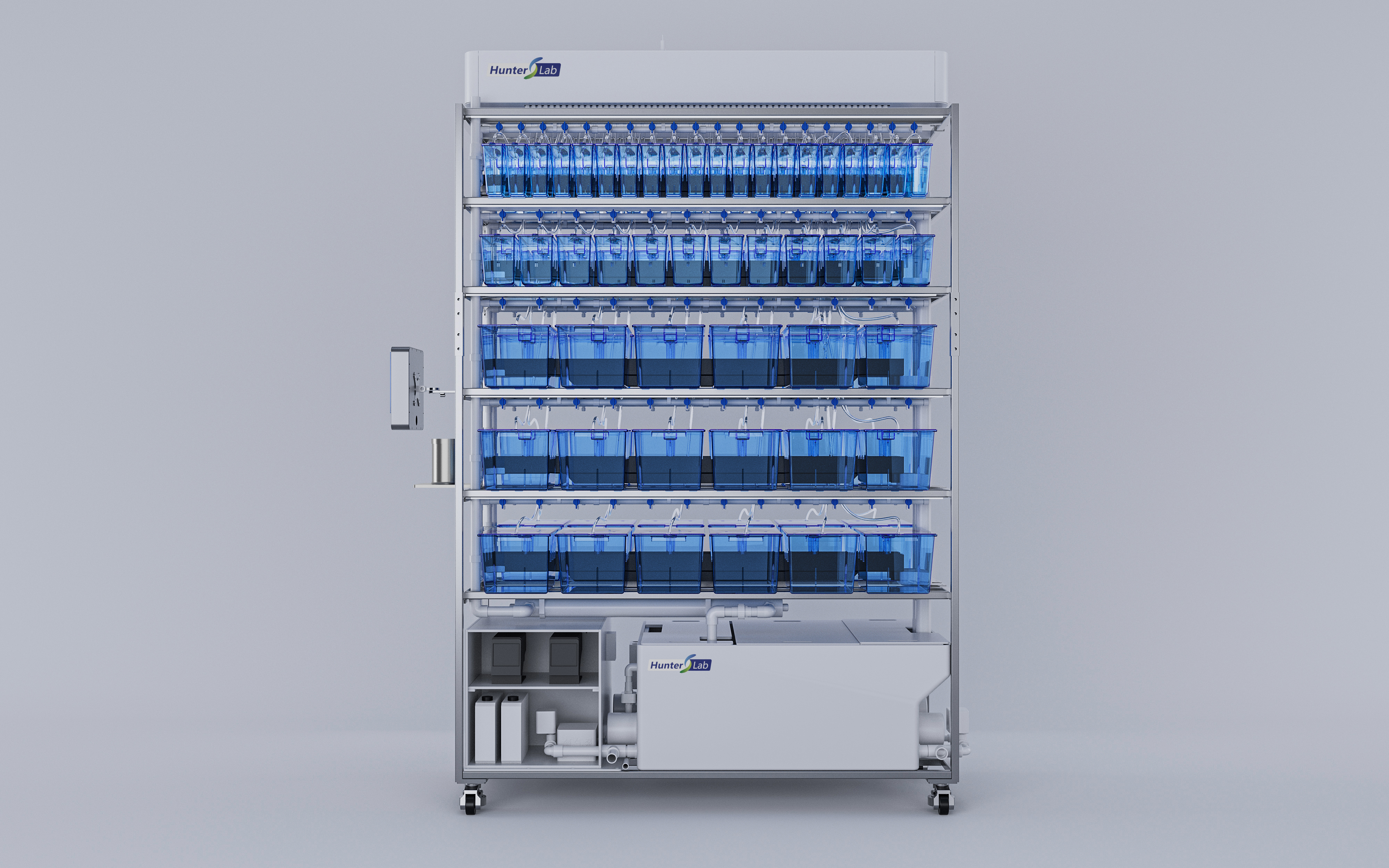
Why temperature quietly shapes spawning and embryo quality
Zebrafish are ectotherms. Their body temperature tracks the water around them, and so does the rate of nearly every biochemical process that supports reproduction. Egg maturation, ovulation, sperm motility, and early cleavage all run on enzymatic reactions with a narrow thermal optimum. Push the water a degree or two outside that range, and the effects show up in ways that are easy to miss at first. Spawning may still happen, but the number of viable embryos can drop. Fertilization rates can slip. Larvae may hatch with subtle developmental delays that only become visible under a microscope.
A zebrafish breeding system temperature control strategy is not just about keeping fish comfortable. It is about keeping the reproductive machinery inside a window where it performs predictably. That window is narrower than many facility managers assume.
The narrow thermal window that supports consistent spawning
The standard recommendation for adult zebrafish husbandry is around 28 degrees Celsius, a figure that appears in The Zebrafish Book and in most facility guidelines. Spawning can occur outside that value, but yield and quality tend to suffer. Water that runs a degree warm can speed up development in ways that desynchronize a batch. Water that runs cool can slow ovulation and reduce the number of eggs released.
The relationship is not perfectly linear. There is usually a plateau where spawning is stable, flanked by zones where performance falls off. The exact boundaries depend on strain, age, and diet. A facility that tracks its own spawn data over time can often identify a local optimum, which may sit slightly above or below the textbook value.
| Temperature range | Typical spawning response | Embryo quality notes |
|---|---|---|
| Below 26 C | Reduced frequency | Slower cleavage, lower hatch rate |
| 26 to 27 C | Moderate | Acceptable for some strains |
| 27 to 29 C | Stable | Best overall yield in most facilities |
| 29 to 30 C | Variable | Faster development, more asymmetry |
| Above 30 C | Suppressed | Stress markers, poor fertilization |
The table is a general guide, not a prescription. Local conditions and genetics shift the edges.
Stability versus setpoint in recirculating breeding systems
A recirculating zebrafish breeding system adds complexity because water moves through filters, pumps, and shared sumps before it reaches any individual tank. That shared plumbing is efficient, but it also means a temperature change in one part of the loop can propagate. A heater that cycles aggressively can send small thermal waves through the entire rack.
Stability is often more important than the exact setpoint. A system that holds 28.0 degrees with very little fluctuation is usually better than one that averages 28.0 but swings between 27.2 and 28.8. Fish acclimate to the average, but the swings add stress and can desynchronize spawning cues. Insulation, slow-response heating elements, and adequate water volume all help dampen those swings.
Heating, cooling, and how water flow affects uniformity
Most facilities focus on heating, but cooling matters too. In a warm room or during summer months, water can drift above the target range even without a heater running. Chillers or heat exchangers are sometimes necessary to keep the system inside the window.
Flow rate is the other variable. Slow flow through a rack can create dead zones where temperature stratifies. Fast flow improves mixing but can stress fish and increase energy costs. The goal is a flow rate that keeps temperature uniform without turning the tank into a current. In practice, that often means balancing manifold design against pump capacity.
-
Check whether the return line is oversized or undersized for the rack.
-
Confirm that each tank receives similar flow, not just the first few on the manifold.
-
Insulate exposed tubing to reduce heat loss between the sump and the tanks.
-
Place temperature sensors at multiple points, not just at the sump.
Monitoring and calibration routines that catch drift early
Temperature sensors drift. A probe that reads 28.0 degrees today may read 27.6 degrees six months from now if it is not calibrated. That kind of error is invisible unless there is an independent check. A handheld reference thermometer used once a month can catch a sensor that has wandered.
Data logging helps too. A continuous record of temperature over weeks reveals patterns that a spot check misses. A slow upward drift during the day, for example, may indicate that the room HVAC is fighting the rack heater. A sudden spike may point to a pump failure or a blocked line. Reviewing those logs on a routine schedule turns temperature data into an early warning system.
| Monitoring practice | Frequency | What it catches |
|---|---|---|
| Handheld reference check | Monthly | Sensor drift |
| Continuous data logging | Ongoing | Daily patterns, spikes |
| Visual inspection of tanks | Daily | Stratification, dead zones |
| Full system calibration | Quarterly | Cumulative error |
A field example and the honest limits of temperature control
A research group in southern China was running a recirculating breeding system and noticed that embryo yield had fallen gradually over several months. Nothing in the protocol had changed. Water quality tests looked normal. A review of the temperature log showed that the average had crept up by roughly half a degree, and the daily fluctuation had grown wider. The heater element had degraded, and the controller was compensating with longer on cycles.
Replacing the element and recalibrating the controller brought the yield back over the following weeks. The case is a reminder that temperature problems often develop slowly. They do not announce themselves with a crash.
Temperature control is powerful, but it is not a cure for everything. Genetics, nutrition, density, and water chemistry all influence spawning. A perfectly controlled temperature will not fix a diet deficiency or an overcrowded tank. The honest position is that temperature is one lever among several, and it works best when the others are already in reasonable shape.
Hunter Lab (Hunter) builds zebrafish laboratory equipment with attention to the environmental control details that affect breeding performance. The manufacturing and quality control side supports the consistency that long-term colony management requires. For facilities looking to tighten temperature control without adding complexity, that kind of build discipline is worth considering.








