
 EN
Why anxiety-like behavior in zebrafish needs careful assay design
Zebrafish are not anxious in the same way humans are. They do not ruminate about the future or worry about social judgment. What they do show is a set of defensive responses to novelty, threat, and uncertainty. Those responses look like what other vertebrates do when they are stressed. That is why zebrafish have become a common model for screening compounds with anxiolytic or anxiogenic potential.
The problem is that behavior is noisy. A fish that stays near the bottom of a tank might be anxious, or it might be cold, sick, or simply not hungry. A fish that moves quickly might be exploratory, or it might be fleeing. A zebrafish behavioral analysis system can track movement with high precision, but it cannot tell you what the movement means. That interpretation comes from the assay design. If the design is sloppy, the data will be clean and wrong.
Choosing a behavioral paradigm that matches the question
Several well-established paradigms exist, and each one captures a different slice of anxiety-like behavior. The novel tank test places a single fish in an unfamiliar tank and measures how much time it spends near the bottom versus the top. The light/dark test uses a tank with a bright and a dark compartment and measures preference for the dark side. The open field test measures general locomotion and thigmotaxis, which is the tendency to stay near walls. The novel object test adds an unfamiliar item to the arena and measures approach or avoidance.
-
Novel tank test: useful for rapid screening, single fish, short duration.
-
Light/dark test: sensitive to photophobia and anxiogenic compounds.
-
Open field: provides baseline locomotion and wall-hugging data.
-
Novel object: measures risk assessment and habituation.
Each paradigm has strengths and weaknesses. A compound that reduces bottom-dwelling in the novel tank test might also reduce overall locomotion, which would look like a false positive. A light/dark test can be confounded by visual impairment or by strain differences in light sensitivity. The right choice depends on the specific question and on what is already known about the compound or the genetic line.
| Paradigm | Primary measure | Strength | Limitation |
|---|---|---|---|
| Novel tank | Bottom vs top time | Fast, simple | Sensitive to locomotion changes |
| Light/dark | Dark preference | Robust anxiolytic signal | Visual and strain confounds |
| Open field | Thigmotaxis, distance | Baseline activity | Less specific to anxiety |
| Novel object | Approach latency | Risk assessment | Requires habituation control |
Environmental control is not optional
Behavior is context dependent. A small change in room temperature, light intensity, or water chemistry can shift the results of an assay more than the treatment itself. That is why environmental control is part of the assay design, not an afterthought.
Light is one of the most common confounds. Zebrafish have a strong preference for dark environments under many conditions, but that preference varies with strain, age, and light intensity. A light/dark box that uses a very bright light may produce ceiling effects, where all fish stay in the dark regardless of treatment. A dim light may produce floor effects. Calibrating the light source and documenting the lux or lumen value is basic good practice.
Water temperature matters too. Fish are ectotherms, and metabolic rate, swimming speed, and stress hormone release all shift with temperature. A rack that runs a degree or two off can change the outcome. The same goes for pH and conductivity. These parameters should be stable and recorded during the assay.
Tracking parameters that actually reflect anxiety
Modern behavioral analysis systems produce a lot of numbers. Distance moved, velocity, acceleration, turn angle, freezing duration, and zone entries are all easy to compute. The challenge is choosing the ones that map onto the biological question. Not every metric is equally informative.
Time in the top zone of a novel tank is one of the most widely used anxiety-like measures. Latency to enter the top zone is another. Freezing, which is a period of immobility, is often used as a fear response. Thigmotaxis, or wall-hugging, is a common measure in open field tests. Some systems also track erratic movement patterns, which may reflect increased arousal.
It helps to report both primary and secondary measures. A primary measure answers the main question. Secondary measures help explain the result. If a treatment reduces bottom-dwelling but also reduces total distance moved, the interpretation is different than if bottom-dwelling alone changes. The tracking system can provide both, but the design has to specify which ones matter.
A field example where assay calibration changed the outcome
A pharmacology group at a university in eastern China was screening a set of compounds for anxiolytic activity using a light/dark box. The first round of experiments produced inconsistent results. Some compounds looked active on one day and inactive on another. The team reviewed the setup and found that the light source had been replaced between sessions without recalibration. The new bulb was brighter, and the fish were spending nearly all their time in the dark compartment regardless of treatment. The assay had hit a ceiling.
After recalibrating the light intensity and adding a daily light measurement to the protocol, the results became reproducible. The compounds that showed activity in the second round were consistent across sessions. The biology had not changed. The environment had.
Data analysis and the honest limits of interpretation
Behavioral data rarely follows a normal distribution. Many metrics are skewed, and some are bounded by zero. Standard parametric tests may not be appropriate. Non-parametric methods, or transformations, are often needed. The analysis plan should be set before data collection, not after, to avoid the temptation to fish for significance.
It is also important to report effect sizes, not just p-values. A statistically significant difference of a few seconds in top-duration may not be biologically meaningful. Confidence intervals help readers judge whether the effect is large enough to care about.
Finally, no assay can fully separate anxiety from other states. A fish that is sick, injured, or cold will behave differently, and that difference may look like anxiety. The assay is a tool, not a mind reader. Good design reduces the noise, but it does not eliminate the need for careful interpretation.
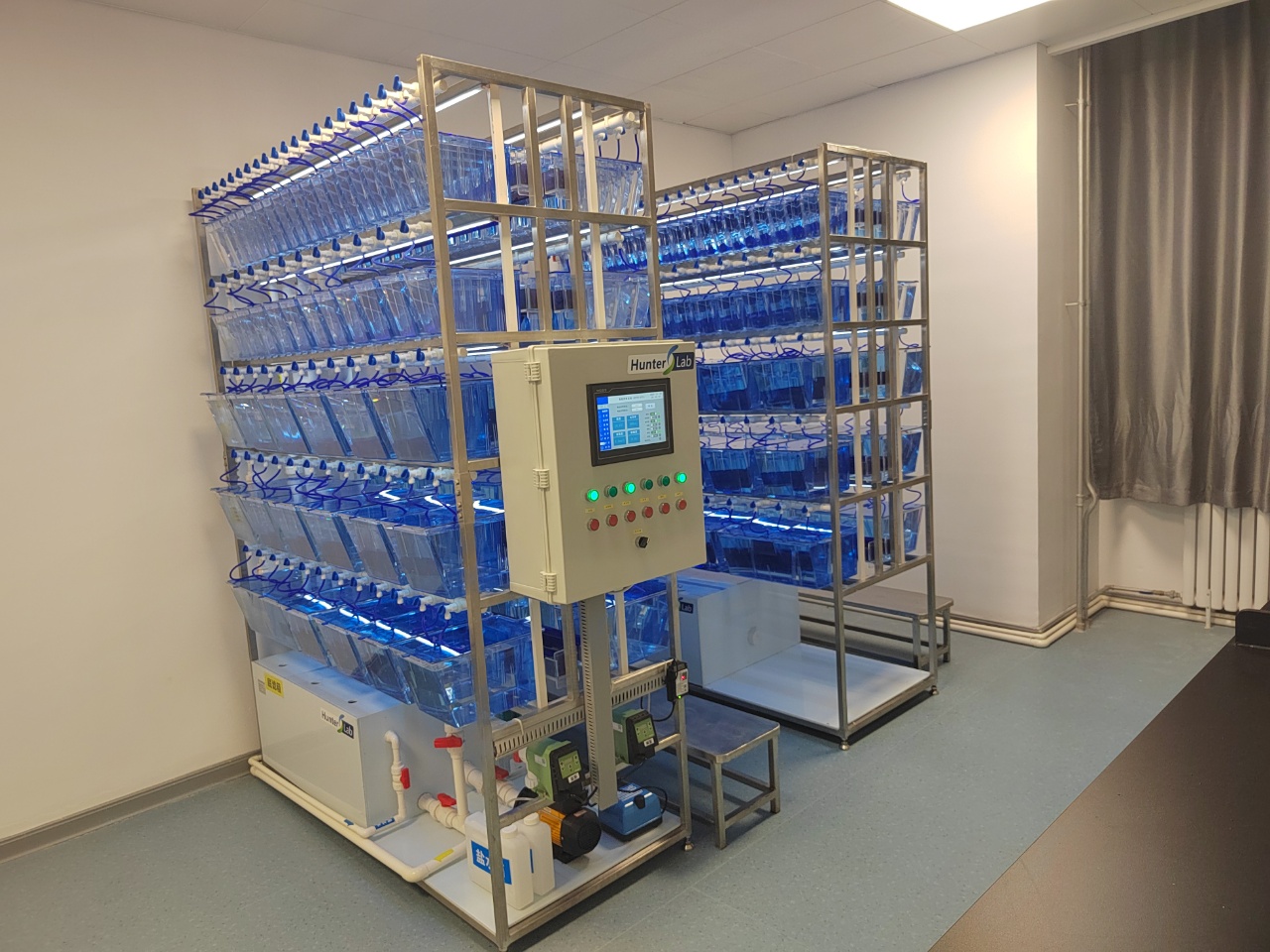
Hunter Lab (Hunter) builds zebrafish laboratory equipment with attention to the environmental stability that behavioral assays depend on. The manufacturing and quality control side supports the consistency that long-term studies require. For labs designing anxiety-like assays, that kind of build discipline is part of the foundation.








