
 EN
A Zebrafish Water Quality Monitor should do more than announce that a reading crossed a line. In a research facility, a short-lived change after feeding, maintenance, or a water exchange may call for observation and a sensor check. A sustained change that is worsening, appears in several parameters, or is confirmed by another measurement needs a faster response. The useful distinction is therefore not simply “in range” versus “out of range”; it is a structured judgment about duration, direction, confidence, and biological context.
For day-to-day users, this distinction matters because water conditions can influence animal welfare and introduce variables into experimental work. Facility guidance commonly calls for alarms when water-quality values leave locally defined ranges, but those limits should be set and reviewed by the facility’s responsible staff. A monitor can support that process; it cannot replace a documented husbandry and escalation procedure.
Start with a baseline, not a single universal limit
Each facility needs a baseline built from its own system design, source water, stocking practice, life stages, and validated husbandry targets. Temperature, pH, conductivity, and dissolved oxygen are often monitored together because one reading can help explain another. A Zebrafish Water Quality Monitor can compare a new value with a configured operating band, but it should also retain a rolling history. Without that history, a small movement and a developing failure can look identical on a dashboard.
Set at least three operational states: a normal band, a warning band for review, and an urgent band for intervention. The numerical boundaries, delay timers, and contacts belong in the facility’s own SOP. This article does not prescribe water-quality setpoints because applicable targets vary with the local system and research protocol.
How temporary deviations are recognized
A temporary deviation is a reading that departs from the expected pattern but returns toward baseline within the facility’s configured observation window. The word temporary should be tied to time-series evidence, not to a staff member’s intuition. For example, a brief conductivity shift following a controlled water exchange may be expected if it settles as the system mixes. The same number that stays displaced, however, is no longer a minor event.
- Short duration: the reading re-enters the normal or warning band within the configured delay period.
- Stable recovery: the trend reverses and remains stable rather than oscillating across an alarm boundary.
- Limited scope: no corroborating change appears in related channels or nearby tanks.
- Plausible operational cause: a logged maintenance action, calibration check, or planned exchange explains the timing.
- Credible signal: probe diagnostics, calibration status, and a manual check do not suggest sensor fouling, disconnection, or communication loss.
This is where differentiation is valuable. A noisy probe should trigger inspection, not a false assurance that the fish are unaffected. In practice, we would log the event and the verification result even when it resolves, because repeated short events can reveal a pattern that a single alarm cannot show.
What turns a deviation into a critical event
A critical deviation is one that exceeds the facility’s urgent action criteria, persists beyond the allowed delay, deteriorates quickly, or is supported by related evidence. A Zebrafish Water Quality Monitor can calculate these conditions from rules rather than from one absolute threshold. It should escalate the event when the risk signal becomes stronger, not merely louder.
| Decision signal | Temporary classification | Critical classification |
|---|---|---|
| Duration | Returns within the configured observation period | Persists beyond the allowed delay or recurs repeatedly |
| Rate of change | Small, slowing movement toward baseline | Fast movement farther from baseline or an accelerating trend |
| Cross-checks | Related values stay stable and a check supports normal operation | Several related signals change together or an independent check confirms the excursion |
| System context | Matches a documented, controlled activity | Coincides with pump, aeration, filtration, flow, or power concerns |
| Sensor confidence | Questionable reading routed to probe inspection | Validated reading with high confidence and an urgent pattern |
Consider dissolved oxygen as an example. A single low-looking point during a probe service window may be a data-quality issue. A sustained fall accompanied by a relevant system alarm has a different meaning and should follow the urgent notification path. The monitor’s job is to preserve both the raw trace and the reasons for its classification, so the response is auditable.
Use persistence and correlation to reduce false alerts
Simple alerting asks, “Did the value cross the limit?” Better alerting asks, “How long has it been outside, where is it going, and what else changed?” A practical rules engine can require consecutive readings, a minimum excursion area over time, or confirmation from a second signal before changing a warning to critical. The exact logic should be validated against facility records before it is relied upon.
Correlation is especially useful when a Zebrafish Water Quality Monitor observes more than one location. A deviation at one probe may point to a local sensor or tank issue. Similar movement across zones can point to a shared supply or recirculation issue. That is a diagnostic lead, not proof; staff still need to inspect the relevant equipment and perform their local verification steps.
Keep people in the escalation loop
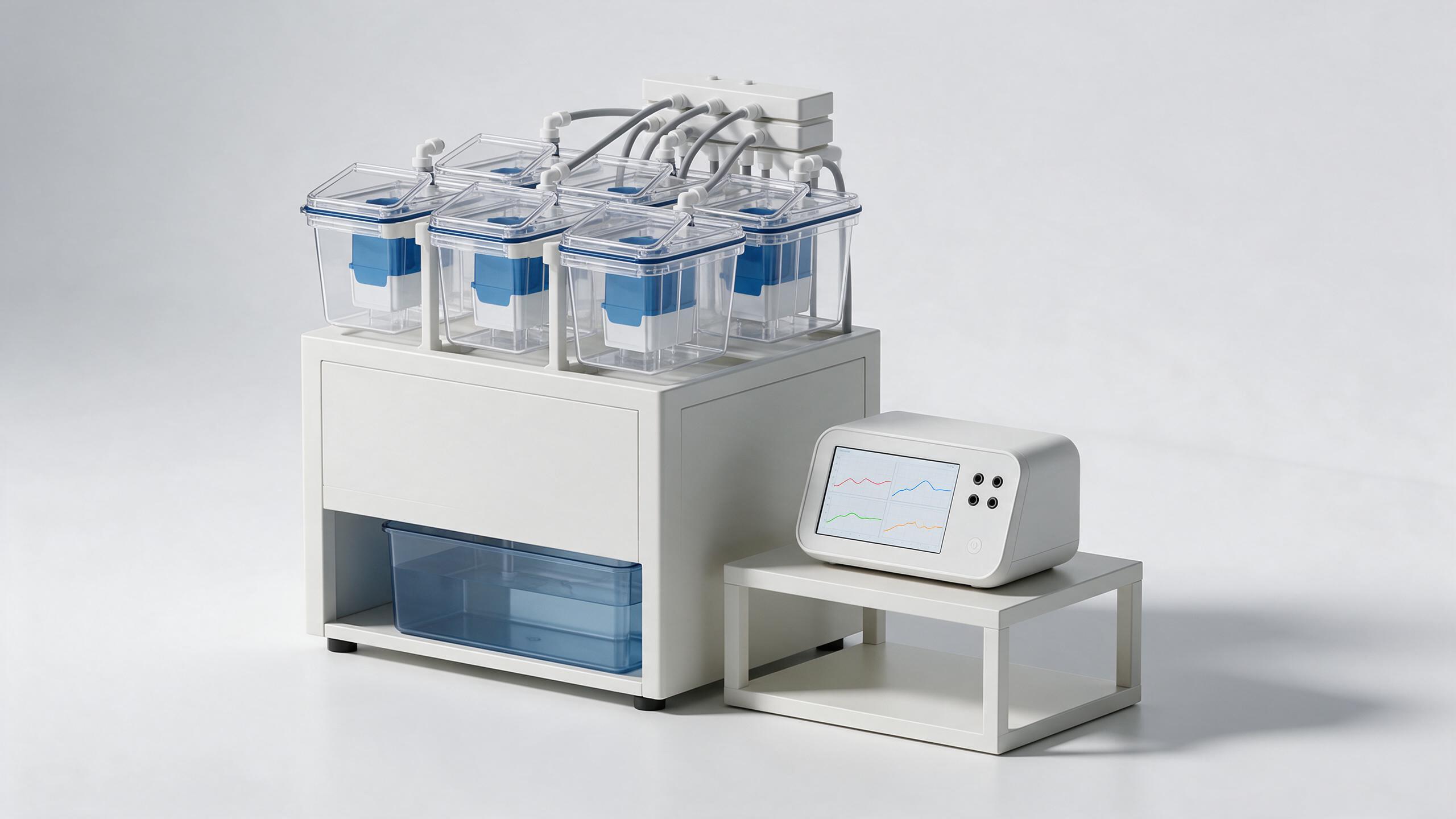
Monitoring software should route an alert to the right person with the parameter, time trace, severity, related signals, and the action record attached. For a warning, the instruction may be to inspect the probe and retest. For a critical event, it may be to notify the designated on-call contact and follow the facility response plan. The monitor should record acknowledgement and resolution, including whether the event was a genuine water-quality change or a sensor issue.
Review these records regularly. If the same deviations appear after routine work, the monitoring configuration or procedure may need revision. If a condition repeatedly starts as temporary but progresses, reduce the delay or add a corroborating rule. That feedback loop is how a Zebrafish Water Quality Monitor becomes a reliable decision-support layer rather than a stream of alerts.
A practical classification checklist
- Confirm the parameter, timestamp, and sensor health.
- Compare the value with the local baseline and the configured warning and urgent bands.
- Inspect the trend: duration, slope, recovery, and recurrence.
- Check related parameters, neighboring locations, and maintenance logs.
- Classify the event using the facility’s documented rules: transient observation, warning, or critical response.
- Record the action and revisit the rule if the outcome reveals a weak point in the differentiation logic.
The central principle is straightforward: a water-quality event becomes more serious when it lasts, worsens, is confirmed, or lacks a credible benign explanation. A well-configured Zebrafish Water Quality Monitor makes those criteria visible, helping laboratory teams respond proportionately while preserving the evidence needed to improve their process.








