
 EN
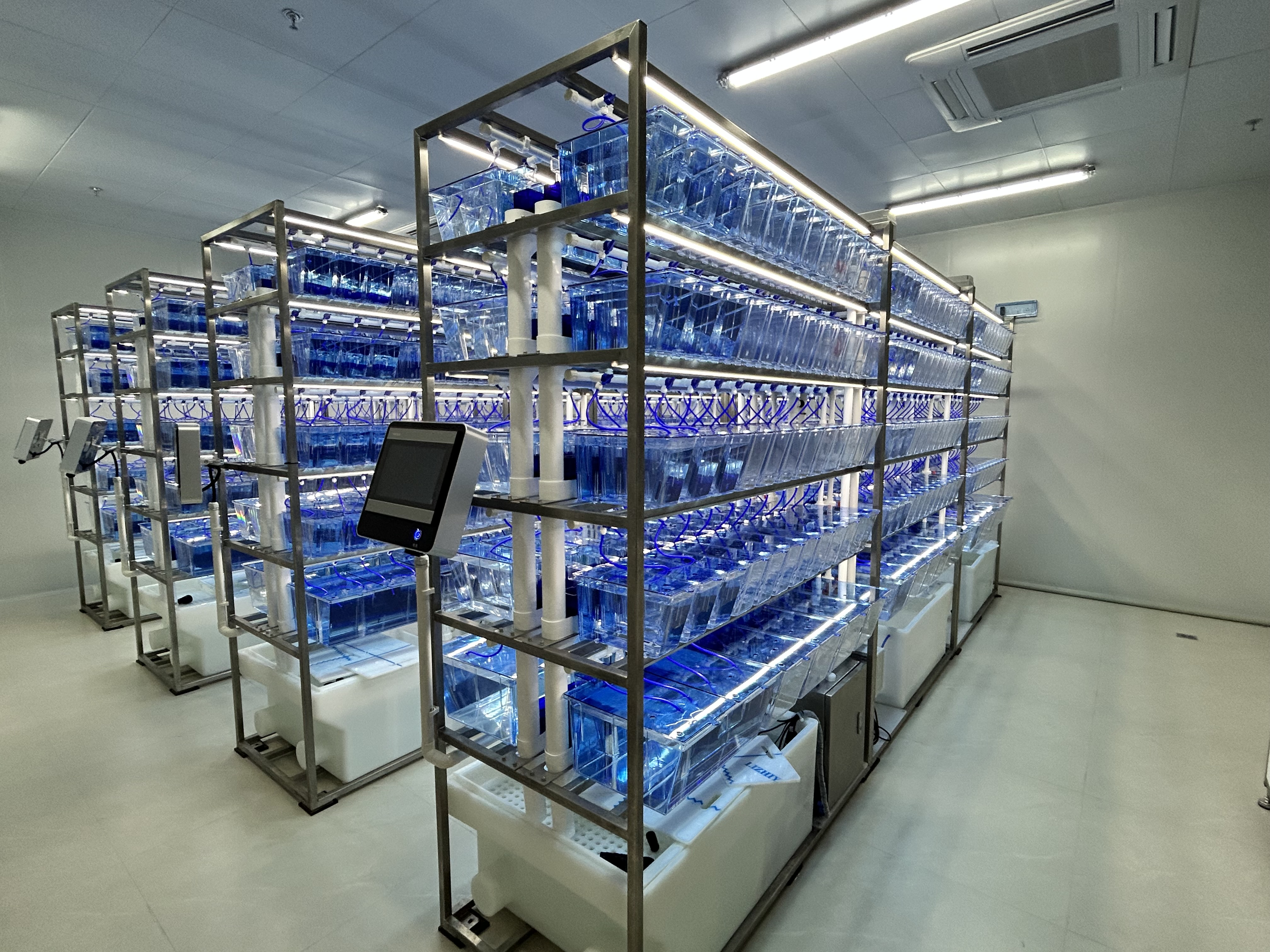
How Does a Zebrafish Trajectory Tracking System Record Swim Paths?
A Zebrafish Trajectory Tracking System turns ordinary-looking swim behavior into a structured record that a research team can review, compare, and analyze. Instead of relying on an observer’s impression of whether a fish moved “more” or “less,” the system records where the fish was at each measurement moment, links those positions in order, and converts the resulting line into behavioral metrics.
The useful output is not simply a video. It is a time-indexed description of movement: position, direction, speed, distance, zone occupancy, and sometimes turning behavior. That distinction matters when a lab needs to compare groups or repeat an assay. A clean trajectory is only as reliable as the acquisition and validation steps behind it.
Start with a controlled video record
Every trajectory begins with imaging. A camera observes a defined arena, well, tank, or lane while the assay is running. The system needs a stable field of view, consistent illumination, and a known relationship between pixels and the physical arena. Before a session, operators commonly define the usable tracking area and exclude edges, reflections, labels, or hardware that could be mistaken for an animal.
For a Zebrafish Trajectory Tracking System, the recording rate determines how densely the path is sampled. A short observation interval may be enough for slow zone-preference behavior, while rapid startle responses or turns need more frequent frames. There is no universal setting: the appropriate frame rate depends on life stage, arena size, expected movement, and the endpoint being measured.
Detect the fish in each frame
Once video is available, the tracking software identifies the fish in each selected frame. Depending on the workflow, it may use contrast, background subtraction, shape detection, or a trained detection model. The result is typically a point associated with the fish, such as a body centroid, head location, or bounding-box center.
This is the first place where a believable-looking path can still be wrong. Shadows, bubbles, glare, a moving reflection, or two fish crossing can disrupt detection. For that reason, a practical Zebrafish Trajectory Tracking System should retain an overlay or review view so users can compare the detected marker with the original footage. Automation reduces repetitive scoring, but it does not remove the need to spot-check difficult frames.
Convert image positions into coordinate mapping
A position in a camera image begins as pixel coordinates. Coordinate mapping connects those pixels to the experiment’s defined space. In a two-dimensional assay, the software may map each detected point to an X and Y location within the arena. Calibration lets the analysis express distance in a meaningful unit rather than only in pixels.
Three-dimensional tracking adds another view or depth method. A published 2024 zebrafish tracking example used synchronized top and side views: the top view supplied the X-Y plane and the side view supplied the X-Z plane. The researchers used a shared axis to merge observations from both views. That example is helpful for understanding the principle, not a specification for every laboratory system. Camera geometry, synchronization, and calibration must be validated for each setup.
Good coordinate mapping also establishes zones. A user may divide an arena into center and perimeter areas, light and dark compartments, or custom regions. When each coordinate is assigned to a zone, the tracking record can show not just how far the animal moved but where it spent time.
Link coordinates into time-stamped data
The software then orders detections by time. A simplified record may look like this: at 0.0 seconds, the fish is at one coordinate; at 0.1 seconds, it is at the next; and so on. The connected sequence is the swim path. The timing label is essential because the same spatial path can represent very different behavior when completed over two seconds rather than two minutes.
Time-stamped data supports common calculations such as total distance, instantaneous or average speed, immobility duration, turning angle, and time in a region. In the published multi-view example, one frame was extracted every 0.1 seconds and the dataset contained 18,490 reconstructed positions. That illustrates how a large collection of individual detections becomes a usable movement series. In a routine assay, the right sampling plan should be selected before the experiment so the output matches the biological question.
Keep identity and continuity intact
For one fish in one arena, continuity is often straightforward: the system links the most plausible detection from one time point to the next. Multi-fish work is more demanding. When animals approach, overlap, or cross, a tracker may need identity rules, motion prediction, or manual review to prevent one fish’s coordinates from being assigned to another.
This is where teams should separate detection quality from trajectory quality. A frame can contain a correctly detected fish, yet the record can still contain an identity switch or an implausible jump. A sensible review routine flags missing detections, sudden changes in location, long gaps, and points outside the defined arena before summary metrics are exported.
Validate the path before interpreting behavior
The final path is an analytical output, not proof by itself. Review representative raw-video segments, confirm calibration, document exclusions, and apply the same rules to all comparison groups. If lighting, water conditions, acclimation, camera position, or handling differ between sessions, those changes can appear in the trajectory record as if they were treatment effects.
For many labs, the most useful workflow is a small validation run followed by a larger study. Compare tracked points with the video, test whether zones and distances match the physical arena, and decide how missed frames will be handled. This is especially important when swim paths are used to support biological conclusions rather than only to screen for obvious movement changes.
What a usable trajectory record should provide
- Original or reviewable video with the detected position overlaid.
- Calibrated coordinate mapping for the assay arena.
- Time-stamped data that can be checked, filtered, and exported.
- Transparent rules for zones, missed detections, and excluded trials.
- Metrics that match the protocol, such as distance, velocity, dwell time, or turning behavior.
Conclusion
A Zebrafish Trajectory Tracking System records swim paths by repeatedly locating the fish in video frames, mapping each location to coordinates, and linking the coordinates into a time-ordered movement record. The strongest results come from the full chain working together: stable imaging, appropriate calibration, trustworthy detection, continuous identity tracking, and documented quality checks. When those elements are in place, the trajectory becomes a reproducible bridge between observed swimming and quantitative behavioral analysis.








