
 EN
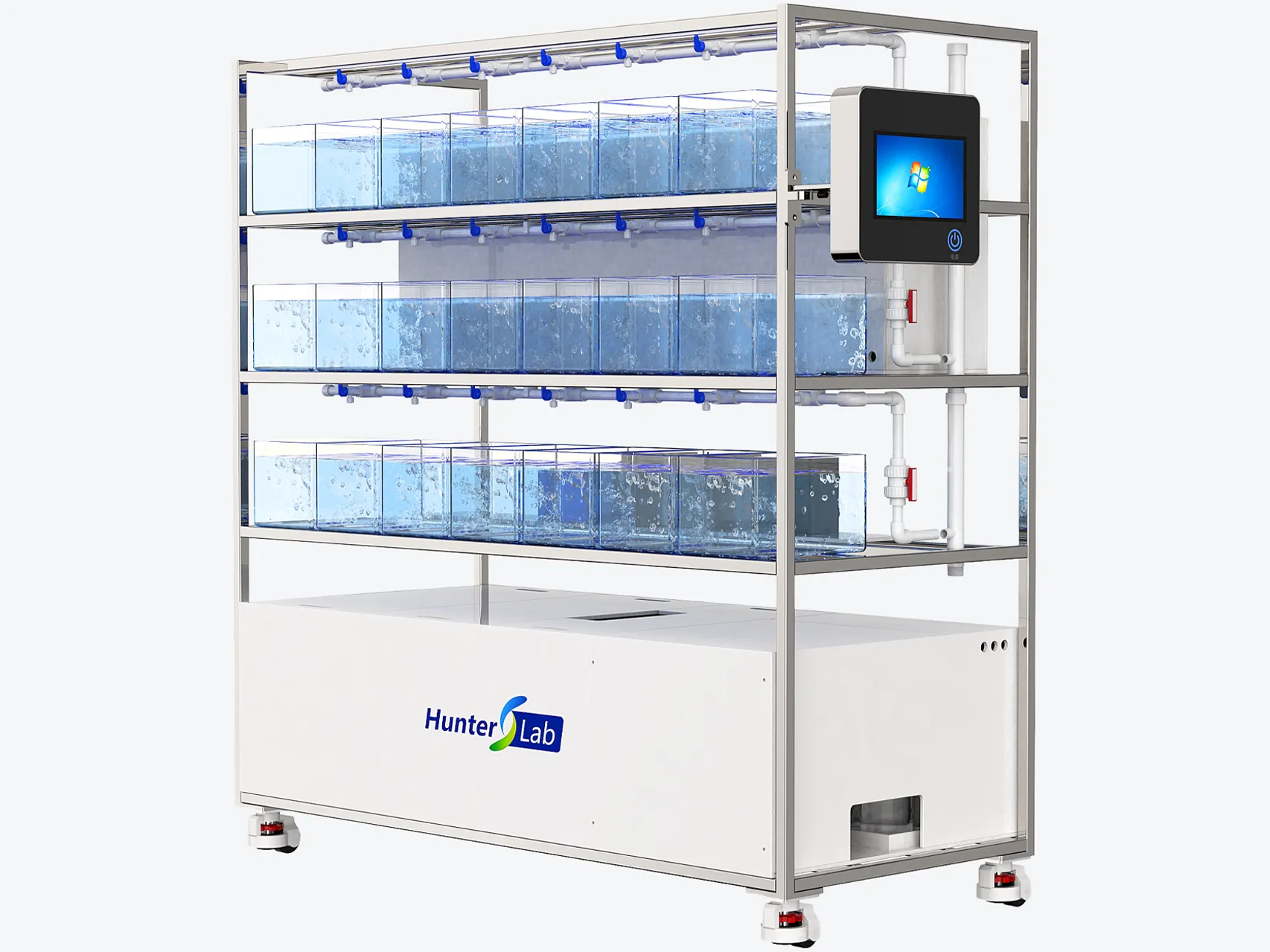
Why Continuous Replacement Beats a Static Bath
A zebrafish flow-through exposure system replaces test water continuously instead of leaving embryos or larvae in a fixed, aging bath. Its job is simple to state but demanding to run. It must deliver a defined amount of test chemical, mix it predictably with dilution water, and replace chamber volume fast enough that losses do not dominate the exposure. When these parts work together, the system can sustain a more reliable constant concentration over a long assay.
For toxicology teams, a pump setting is not an exposure result. The result is the measured concentration in the chamber where zebrafish live. A well-designed flow-through arrangement makes that concentration easier to maintain, sample, and interpret. Every chamber has routes by which chemical can leave: outgoing water, adsorption to tubing or walls, degradation, volatilization, uptake by organisms, and settling. Continuous flow counters that drift by adding fresh medium while removing an equal amount of chamber liquid.
How Dosing and Dilution Streams Set the Nominal Target
The dosing train begins with a prepared stock or source solution. A metering device delivers that source at a controlled rate into a carrier water stream or mixing vessel. The dilution stream sets the final nominal concentration. The dosing stream determines how much chemical enters the system. Both streams must be compatible with the planned exposure range and with the chemical behavior in water.
Good dosing practice focuses on consistency, not only on paper precision. The pump should be calibrated at the actual operating rate. The stock should be protected from changes that alter its composition. Connections should be checked for leaks, bubbles, backflow, or pulsation. A small air bubble can change delivered volume. A partially blocked line can quietly lower chemical input. Teams often verify actual flow gravimetrically or volumetrically instead of relying only on a pump display.
Mixing, Residence Time, and Chamber Hydraulics
After dosing, the test chemical needs enough mixing to become representative before the medium reaches zebrafish chambers. Poor mixing can create a brief high concentration slug near the inlet and a lower concentration elsewhere. A mixing chamber, coil, or designed manifold gives streams time to combine, but it also adds residence time. That delay should be understood during startup, concentration changes, and troubleshooting.
Chamber design matters too. The inlet should distribute fresh medium without excessive shear or dead zones. The outlet should maintain the intended water level and turnover. If water short circuits from inlet to outlet, a sample near one point may not represent exposure throughout the chamber. If flow is too low for chamber volume, a constant concentration may take too long to establish after startup.
Verification Turns Nominal Into Actual Exposure
A zebrafish flow-through exposure system maintains a nominal target through controlled input and output, but analytical sampling establishes whether the target is achieved. Samples should be collected from relevant locations, such as freshly mixed feed and representative exposure chambers, at planned intervals. The purpose is to compare measured values with nominal values and to identify trends across time or treatment levels.
This distinction is especially important for hydrophobic, volatile, reactive, or light sensitive compounds. Published work on flow-through passive dosing has described continuous supply of aqueous solutions for aquatic toxicity testing. OECD guidance notes that a solvent stock approach may fail to provide stable exposure for difficult substances. The practical lesson is not that one configuration fits every chemical. It is that measured concentration data must guide the protocol.
| Control Point | What It Confirms | Common Failure |
|---|---|---|
| Dosing flow | Chemical input rate | Pump drift, air lock |
| Dilution flow | Nominal concentration | Tubing aging, partial blockage |
| Mixing path | Uniform feed | Short circuiting, dead zones |
| Chamber turnover | Replacement rate | Low flow, restricted outlet |
| Analytical sample | Actual exposure | Sorption, degradation |
A Practical Control Loop for Stable Exposure
Prepare a suitable source. Confirm stock concentration, solvent limits where applicable, storage conditions, and compatibility with tubing and vessel materials. Calibrate liquid paths. Measure both dosing and dilution flows at the rates used in the assay. Record the expected ratio and check for pump drift. Establish mixing before exposure. Run the system long enough for the feed path and chamber volume to approach steady conditions before introducing sensitive test stages. Maintain balanced inflow and outflow. Keep chamber turnover consistent, with no overflow, siphoning, or restricted outlet that changes water level. Sample the real exposure. Analyze chemical concentration at the chamber, not only the stock bottle. Review whether values remain within the study acceptance range. Document deviations promptly. A line change, power interruption, air lock, or stock replacement can affect exposure history and should be traceable in the study record.
What Makes a System Fit for the Study
A suitable setup is not necessarily the most elaborate one. It is the one that can hold the intended concentration range, provide repeatable conditions across treatment groups, and generate records that explain what the fish were exposed to. Before a formal study, run a water only commissioning check, verify each channel turnover, and perform a chemical specific shakedown when feasible. Include blanks and controls appropriate to the vehicle and study design.
Hunter Lab supports zebrafish laboratories with flow-through exposure systems and environmental control equipment built for controlled aquatic research. The company's experience covers dosing train design, chamber hydraulics, and the operational realities of maintaining zebrafish research programs. For facilities evaluating flow-through options, Hunter Lab offers a partner that understands how dosing, mixing, turnover, and analytical verification work together to produce defensible exposure data.








