
 EN
Why the larval stage is the toughest part of the pipeline
Zebrafish larvae are fragile in ways that adults are not. For the first few days after hatching, the digestive tract is still maturing, the swim bladder is inflating, and the fish are entirely dependent on what drifts past them in the water. Miss a feeding window, and the consequences show up fast. Larvae that do not eat within a certain window after yolk absorption will not recover. They stall, sink, and die. In a facility that runs multiple lines and overlapping experiments, keeping every larval tank on schedule is one of the hardest operational challenges.
Manual feeding depends on a person being there at the right time with the right food. That works until a meeting runs long, a weekend shift gets thin, or a batch of paramecia or rotifers is not ready. Automated feeding systems change that dependency by making delivery consistent, but the benefit is not just convenience. It shows up in survival curves.
The specific feeding challenges that larvae present
Larval zebrafish do not eat like adults. They need small live prey, typically rotifers or paramecia in the early days, transitioning to brine shrimp nauplii as they grow. The prey has to be in the water column at the right density. Too sparse, and larvae expend energy hunting without success. Too dense, and the water quality crashes. Both extremes kill larvae.
Frequency matters as much as density. Larvae have small stomachs and fast digestion. A single daily feed is rarely enough. Multiple small feeds throughout the light phase produce better growth and higher survival than one large feed. That schedule is hard to maintain by hand, especially across many tanks. It is exactly the kind of repetitive, time-sensitive task that automation handles well.
-
Prey density must stay within a narrow range.
-
Feeding frequency needs to be high, often several times per day.
-
Prey must be distributed evenly, not dumped in one spot.
-
Uneaten prey and waste must not accumulate.
How automated delivery keeps prey density in the sweet spot
An automated feeding system for larvae is not the same as an adult feeder. It has to handle live prey, which settles, clumps, and dies if handled roughly. The delivery mechanism has to be gentle. Peristaltic pumps, air-driven dispensers, and small screw augers are common approaches. The goal is a controlled, repeatable dose that lands in the water column rather than on the bottom.
Consistency is where automation earns its keep. A manual feed might deliver a slightly different volume each time, depending on how the culture was poured or how much was left in the container. An automated system delivers the same dose every cycle. Over a larval rearing period, that consistency reduces the variance in growth and survival between tanks. It also makes it easier to compare treatments in an experiment, because the feeding variable is no longer a source of noise.
| Parameter | Manual feeding | Automated feeding |
|---|---|---|
| Dose accuracy | Variable | Repeatable |
| Frequency per day | Limited by labor | Programmable |
| Weekend coverage | Staff dependent | Unattended |
| Prey distribution | Depends on technique | Consistent |
| Record of delivery | Manual notes | Digital log |
Reducing handling stress and human error
Every time a person opens a tank lid, there is a small disturbance. Light enters, vibration travels through the rack, and the fish react. For larvae, that disturbance can interrupt feeding and push them away from the prey. Automated systems reduce the number of lid openings by delivering feed through a port or a fixed line. Fewer disturbances mean more uninterrupted feeding time.
Human error is another factor. A tired technician on a Sunday morning might misjudge a dose, skip a tank, or double-feed a row. Those mistakes are not malicious, but they show up in survival data. Automation does not eliminate error, but it removes the most common ones. The errors that remain tend to be mechanical, and they can be caught by alarms or by routine checks.
The water quality connection that often gets overlooked
Feeding and water quality are linked. More feed means more waste, and larvae are messy eaters. Uneaten prey decays, ammonia rises, and dissolved oxygen drops. A manual feeding schedule that overfeeds to compensate for missed feeds can push a larval tank into a water quality spiral. An automated system that delivers precise, frequent small doses avoids that overcorrection.
This is where integration with the rack's water management matters. If the facility uses a recirculating system, the filter has to handle the additional load. If the larval tanks are static, water changes have to keep pace. Automated feeding does not solve water quality by itself, but it makes the feeding input more predictable, which makes water quality easier to manage.
A field example from a facility that switched to automated larval feeding
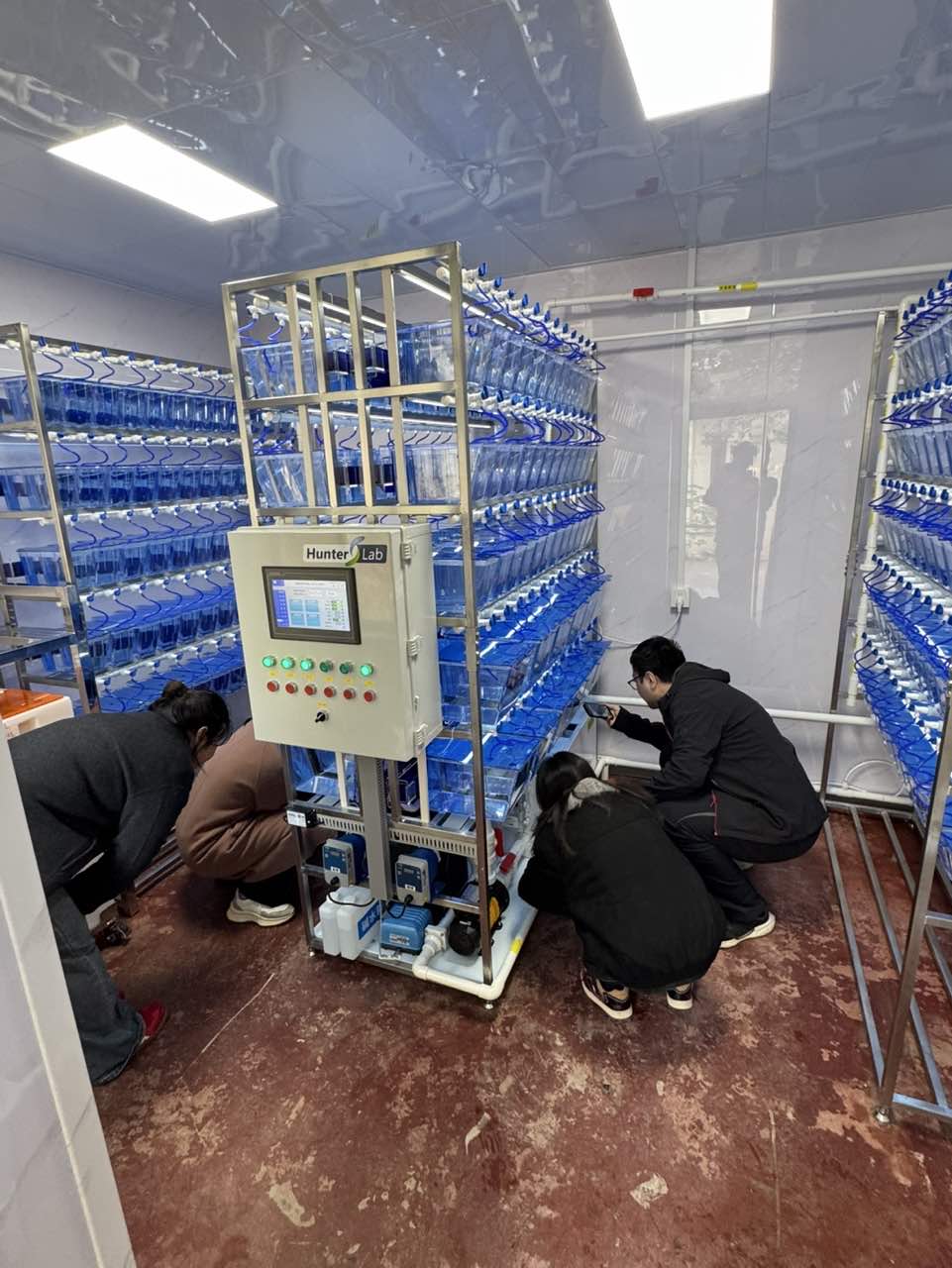
A multi-rack facility in eastern China had struggled with variable larval survival for several seasons. The adult colony was healthy, spawning was reliable, and the water parameters were within range. The problem was concentrated in the larval rearing room. Survival from hatching to the juvenile stage swung widely between batches, and the cause was not obvious.
A review of the feeding logs showed that larval tanks were being fed at different times depending on who was on duty. Weekend feeds were sometimes late or skipped entirely. The facility installed automated feeders on the larval racks, programmed for multiple small feeds during the light phase. Over the following months, the batch-to-batch variation in survival narrowed. The average survival did not jump overnight, but the low outliers became less frequent. The improvement was not dramatic in a single number. It was a reduction in the tail of the distribution, which is often what matters most in a production facility.
Where automation helps and where it cannot substitute for care
Automated feeding is not a cure for poor husbandry. It cannot fix a contaminated prey culture, a temperature problem, or a disease outbreak. It also cannot judge whether larvae look healthy or whether a tank has an unusual number of dead fish. Those observations still require a person.
There is also a maintenance burden. Lines can clog, pumps can fail, and prey can die in the reservoir if it is not refreshed. A facility that installs automated feeders without a cleaning and monitoring routine will eventually see failures. The technology is a tool, and like any tool, it works best when someone is paying attention.
Hunter Lab (Hunter) builds zebrafish laboratory equipment with attention to the daily realities of larval rearing. The manufacturing and quality control side supports the consistency that long-term colony management requires. For facilities looking to stabilize larval survival without adding labor, that kind of build discipline is part of the foundation.








