The real bottleneck in zebrafish screening isn’t the fish, it’s the handling
Anyone who has run a fish embryo acute toxicity test knows the drill. You plate newly fertilized eggs, dose them, then come back at 24, 48, 72, and 96 hours to score coagulation, somite formation, tail detachment, and heartbeat by eye under a dissecting scope. That is fine for a dozen compounds. It falls apart when a formulation chemist drops forty mixtures on the bench and asks for ranking by Friday.
The zebrafish model itself is not the limiting factor. A single female can lay hundreds of embryos in one clutch, and the embryos are transparent, so developmental endpoints are visible without dissection. The constraint sits upstream and downstream of the biology: consistent dosing across a multi-well plate, repeatable orientation for imaging, and a data pipeline that does not depend on a tired graduate student squinting at the fourth plate of the afternoon.
That is the gap a zebrafish toxicological exposure system is built to close. The hardware does not replace the assay. It makes the assay behave the same way on plate one and plate ninety.
Where the FET guideline stops and the engineering problem begins
OECD Test Guideline 236, the Fish Embryo Acute Toxicity test, gives a clean regulatory anchor. Newly fertilized zebrafish eggs are exposed for 96 hours, with observations every 24 hours against four apical endpoints, and an LC50 is derived from those observations. The guideline is deliberately lean. It tells you what to observe, not how to move hundreds of embryos through a dosing and imaging workflow without introducing plate-to-plate drift.
That distinction matters in practice. A laboratory can follow TG 236 to the letter and still produce data that another laboratory cannot reproduce, because the uncontrolled variables sit in the space between the written method and the bench. How long embryos sit in a dry well before dosing. Whether the chorion is intact or removed. How often exposure media is renewed. How larvae are positioned for imaging. None of these are trivial details when the endpoint is a morphological abnormality scored on a five-point scale.
An exposure system attacks those variables mechanically. Automated loading pulls embryos from a reservoir and places them into wells with a repeatable volume. Immobilization modules orient larvae in a defined plane so the imaging module sees the same anatomical landmarks every time. Software then batches the image analysis, which removes the human judgment call that creeps in after the first two hundred wells.
Why throughput numbers alone are a poor buying criterion
Vendors love a headline throughput figure. A workstation rated at hundreds or even a thousand larvae per hour sounds decisive until the actual workflow is mapped out. Throughput only becomes useful when it is paired with a readout that still means something toxicologically.
Consider the trade-off a screening lab actually faces. Push plate density up, and the imaging field of view gets crowded, which degrades resolution on subtle endpoints like pericardial edema or yolk sac resorption. Add anesthesia to keep larvae still, and you introduce a chemical confounder that can interact with the test article. Skip anesthesia and rely on mechanical immobilization, and the hardware has to hold a live, wriggling organism in a fixed orientation without damaging it.
A system that claims high throughput but cannot preserve the morphological detail needed for a developmental toxicity call is just generating low-value images faster. The better question is not “how many per hour” but “how many usable, scored endpoints per hour after quality control.” Those are different numbers, and the second one is almost always lower.
A side-by-side look at what the platform actually changes
The table below compares a manual bench workflow against an automated exposure and imaging workflow on the dimensions that decide whether a screening campaign is viable. The figures are directional, drawn from published comparisons and typical lab experience, and will shift with plate format, endpoint panel, and operator skill.
| Dimension |
Manual bench workflow |
Automated exposure system |
| Dosing consistency across plates |
Operator-dependent; drift increases with plate count |
Programmed volumes and timing; plate-to-plate variation reduced |
| Larvae orientation for imaging |
Hand-placed; orientation varies between wells |
Mechanical immobilization in a fixed plane |
| Imaging throughput |
Limited by microscope time and scorer fatigue |
Batch acquisition driven by software schedule |
| Data traceability |
Notebook entries and local image folders |
Linked image, well, and endpoint records |
| Time to a scored dataset |
Days to weeks depending on compound count |
Compressed into a shorter, more predictable window |
| Main failure mode |
Inconsistent endpoint calls near the plate edge |
Upstream fluidics or imaging calibration drift |
The cost argument also deserves a reality check. A 2026 announcement from Korea’s National Institute of Environmental Research, tied to the first OECD project on zebrafish embryo developmental neurotoxicity, put zebrafish embryo methods at roughly one-fiftieth the cost of conventional rodent testing and more than tenfold faster for screening. That is a powerful framing for portfolio-level decisions. It does not mean every individual assay is fifty times cheaper on day one. Fixed costs, method development, and validation still land on the balance sheet.
The reproducibility problem nobody escapes, and how exposure hardware helps
The uncomfortable truth about zebrafish toxicology is that the model’s regulatory reach has been held back less by biology than by inconsistency. The NIEHS-led SEAZIT program, a systematic evaluation of zebrafish in toxicology, identified deficits in consistent protocol elements, unclear understanding of chemical absorption and metabolism in the embryo, inconsistent endpoint classification, and inconsistent informatics approaches as barriers to broader adoption.
An interlaboratory study run through SEAZIT found measurable differences in potency when laboratories used their own in-house protocols, which directly underscores why exposure variables need harmonization before cross-lab comparison can mean anything. The chorion is part of that story. Leaving it intact versus removing it changes what reaches the embryo. Static exposure versus static-renewal changes the effective concentration over ninety-six hours. These are not exotic edge cases. They are the default conditions of a method that has not been fully locked down.
Automation cannot solve the biology. It cannot make a zebrafish embryo metabolize a pro-toxicant exactly the way a human liver would, and OECD TG 236 itself acknowledges that metabolic capacity in embryos is not always equivalent to juvenile or adult fish. What automation can do is hold the physical exposure variables steady while the laboratory works out the biological ones. That is a narrower promise than “standardized toxicology,” but it is the honest one.
What to look for when the system has to survive a real lab
A short list of criteria separates a demo unit from a platform that holds up after eighteen months of daily use:
-
Fluid path cleanability. Exposure lines that cannot be flushed and verified will carry compound between runs. Ask how the system handles a lipophilic test article that adsorbs to tubing.
-
Immobilization gentleness. Orientation consistency is worthless if the method damages the larvae or alters the endpoint being scored. Live-imaging without anesthesia is preferable when the hardware can manage it.
-
Software audit trail. A scored endpoint should trace back to the image, the well, the plate, and the run parameters without a manual spreadsheet stitch.
-
Service footprint. A system that depends on a remote engineer for a blocked nozzle will sit idle. Local technical response and spare-part logistics are part of the performance envelope.
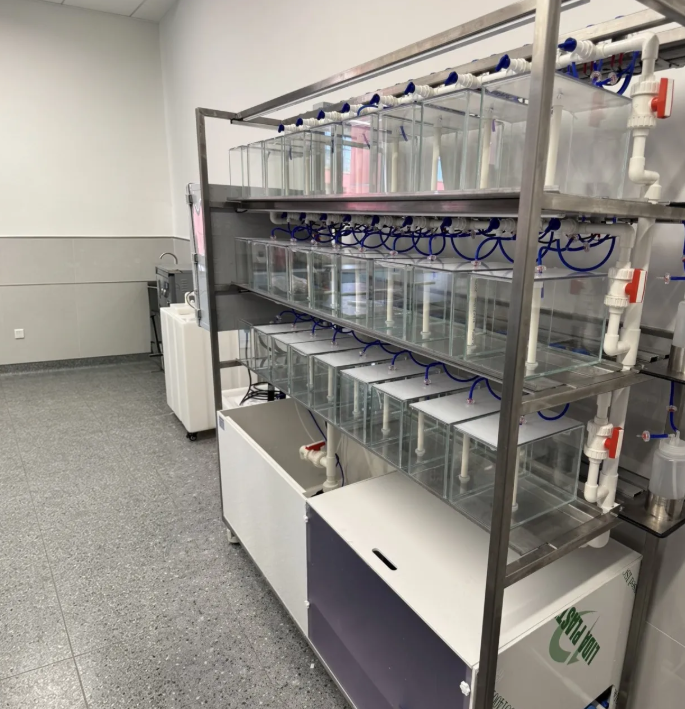
One concrete example from a university lab in Zhejiang makes the point about service and build quality better than a spec sheet. A zebrafish aquaculture system installed there ran for two years with a reported failure rate below one percent, and the lab later credited responsive technical support with helping it clear a GLP accreditation review. The exposure workstation and the aquaculture rack are different products, but they come from the same manufacturing discipline: fluid handling that does not leak, control boards that do not drift, and a supply chain that can put a replacement part on a bench before the experiment queue stalls. Hunter Lab builds both, and the engineering culture that produces a low-failure-rate rack is the same one that sits behind its DanioAuto high-throughput workstation line. For a screening lab, that matters more than a glossy throughput number, because an exposure system is only as good as its uptime.
The zebrafish model has earned its place in chemical safety screening. The next step is making the hardware around it boring and reliable enough that the biology gets the attention.

 EN