
 EN
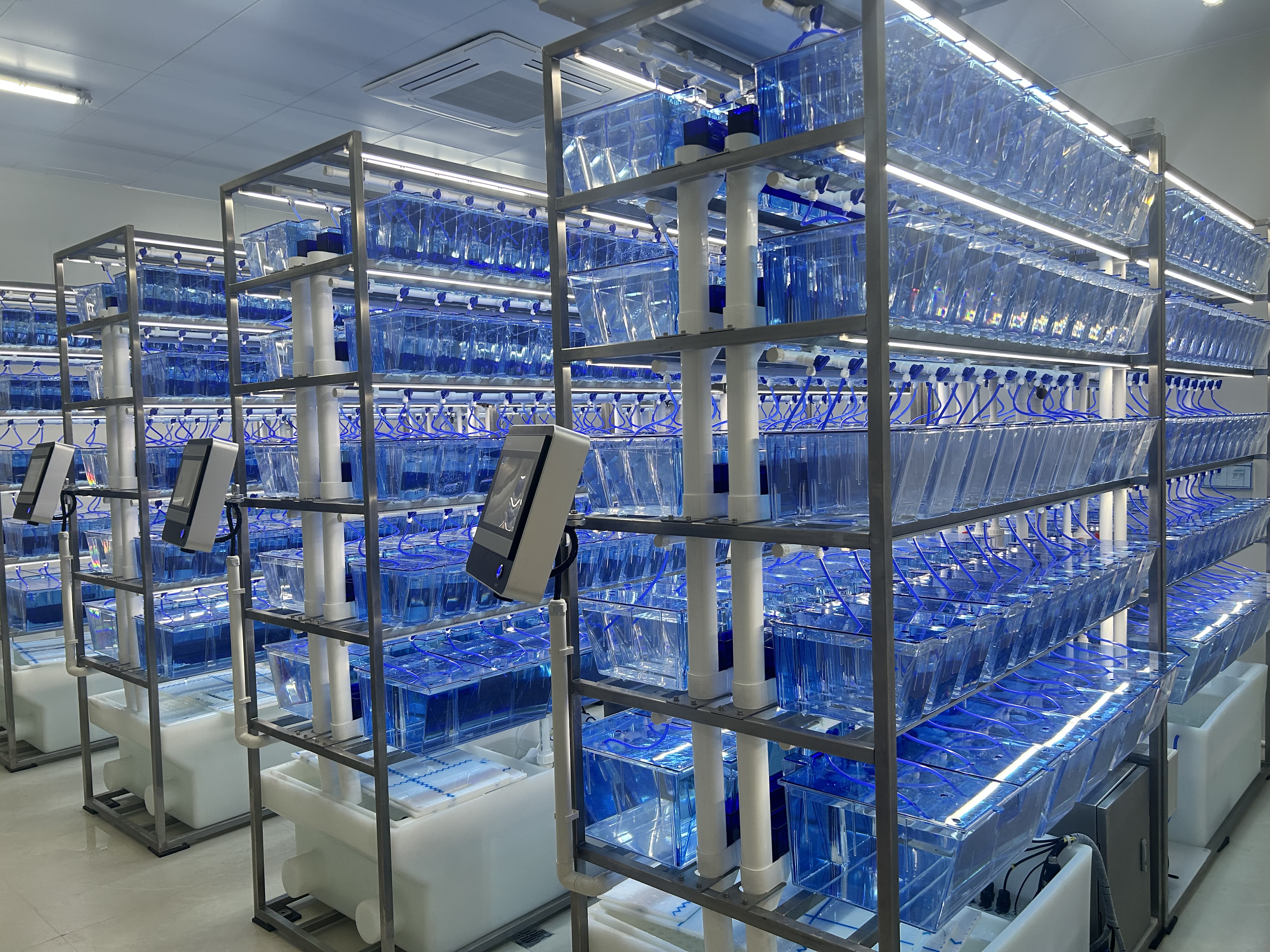
A zebrafish behavioral analysis system enables non-invasive assessment of neurological function.
For a neuroscience team, a Zebrafish Behavioral Analysis System is most useful when it turns a visible response into a traceable experimental record. Rather than treating a swim pattern as a diagnosis, the system gives researchers a non-invasive way to measure how an animal moves, responds, pauses, or changes activity under controlled conditions. That distinction matters: behavior can provide meaningful evidence about neurological function, but it must be interpreted with the assay design, developmental stage, and environmental conditions in view.
A well-planned Zebrafish Behavioral Analysis System brings acquisition, automated tracking, and endpoint extraction into one workflow. The aim is not simply to collect more video. It is to create comparable observations across plates, days, and treatment groups so that a behavioral difference can be examined rather than guessed.
Why non-invasive behavioral assessment is valuable
Zebrafish are especially useful for observing behavior because larvae and adults can be monitored while alive and moving. The setup can capture locomotor activity, trajectory, velocity, turning, zone preference, startle-related movement, or response to a controlled light or sound cue without a surgical readout. Those measures can support an assessment of function while preserving the animal for longitudinal observation or follow-up work.
Non-invasive does not mean context-free. Temperature, illumination, vibration, acclimation time, plate geometry, stocking density, age, strain, and time of day can each alter the behavior being recorded. For that reason, the setup is a measurement environment, not merely a camera. Stable conditions and documented settings are part of the result.
What the system actually measures
At the level of an individual fish or a group, the analysis workflow converts video into defined endpoints. Common examples include distance traveled, average velocity, active versus inactive time, thigmotaxis-like edge preference, turn frequency, burst movement, and response latency after a stimulus. The right endpoint depends on the biological question. A broad reduction in movement may reflect altered neurological function, but it may also reflect sedation, developmental delay, poor water quality, or a visual or muscular limitation.
This is why endpoint selection should happen before recording begins. When the question concerns stimulus processing, the workflow should pair a documented stimulus protocol with timing markers and a pre-specified response window. When the question concerns spontaneous locomotion, the workflow should distinguish acclimation from the measurement interval. A result becomes more credible when the analysis plan names what the metric can show and what it cannot establish alone.
From video to interpretable neurological evidence
The practical workflow has three connected stages. First, the Zebrafish Behavioral Analysis System acquires usable video with sufficient contrast, stable framing, and known timing. Second, automated tracking identifies the animal or its position over time. Third, the software extracts endpoints using rules that are consistent across groups. Recent automated tracking resources and behavioral phenotyping work reflect this same acquisition–tracking–endpoint logic, including approaches that classify more complex seizure-associated behaviors at scale.
Automation is valuable because it reduces the need for a person to score every movement manually. Still, the analysis workflow should not hide its assumptions. Review representative tracks, inspect failed detections, and retain raw or reviewable video where protocol and storage policy allow. If the imaging room fluctuates in temperature or light, the calculation needs adjustment; otherwise, a clean-looking dataset can carry an avoidable confound.
Design choices that protect data quality
Standardize the environment before scaling up
Before comparing treatments, use the tracking workflow to establish a local baseline with the intended strain, age, plate format, and lighting program. Record water temperature, exposure settings, stimulus intensity, and acclimation duration. These details help a team decide whether an apparent group difference is a neurological signal or an experimental drift.
Use controls that answer the real question
The system gains interpretive strength from controls. Vehicle controls, repeated baseline runs, and positive controls appropriate to the assay help identify whether the pipeline detects expected changes. Where a finding is important, combine behavioral endpoints with another relevant measure, such as morphology, viability, imaging, molecular markers, or a second behavioral paradigm. Behavior is often an early functional indicator, not a standalone diagnosis.
Make tracking reviewable
When the system reports an outlier, look at the underlying trace before excluding it. A tracking error, a well-edge reflection, or an immobile animal can change a summary statistic. Predefining exclusion rules and documenting manual review makes the assessment easier to reproduce and easier to explain.
How to choose endpoints for different neurological questions
For general activity screening, the analysis plan may prioritize distance, speed distribution, and active time. For sensory or startle questions, latency, response probability, and post-stimulus trajectory can be more informative. For complex phenotyping, researchers may combine movement features over time rather than rely on one threshold. The key is to link each endpoint to a biological hypothesis before the study starts.
It is tempting to equate a single behavioral change with neurological impairment. A more defensible approach is to describe what the workflow observed: for example, a change in movement pattern under a defined protocol. Then test alternative explanations and add corroborating measures where the decision requires stronger evidence. That language preserves the value of assessment without overstating function.
A practical checklist for implementation
- Define the neurological question and the behavioral endpoint before recording.
- Use the system under documented light, temperature, timing, and plate conditions.
- Include acclimation and controls that match the assay objective.
- Validate tracking with representative videos and retain a review path for outliers.
- Interpret behavior alongside viability, morphology, or other relevant evidence when conclusions carry high stakes.
Turning behavioral observations into better decisions
The system can make neurological assessment more systematic, scalable, and non-invasive when its outputs are tied to a disciplined protocol. Its value comes from repeatable acquisition, transparent tracking, and endpoints chosen for a specific biological question. Researchers who standardize the environment and state the limits of each metric can use behavioral data to prioritize follow-up experiments with greater confidence.
In short, this approach is not a substitute for careful neurobiology. It is a structured way to observe function in vivo, identify meaningful behavioral changes, and decide what evidence should come next.








